|
by Gerald Warner, Softball
Pitching
Instructor

Young pitchers…and often
even those with years of experience… can develop a
“leaping” problem.
Pitching rules (for girls and
women) state that a pitcher cannot become totally
airborne during the pitching sequence…at least one foot
has to remain in contact with the ground until the
other foot lands.
We are often asked what a pitcher can do
to correct this problem. Here is our
reply to a
recent e-mail:
The
leaping problem is a pretty common one…even for many
girls with a lot of pitching experience.
Typically, a
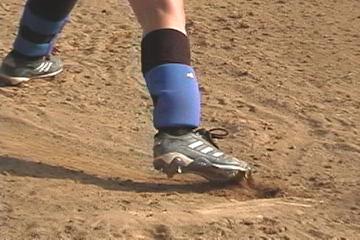
pitcher often forgets to keep her drag toe
down when she becomes too aggressive and starts throwing
harder. So leaping is usually the result of
putting more effort into the pitch. It
can be corrected without shortening the stride or
slowing down the
pitch.
The
toe-drag should be light enough just to remain in
contact with the ground, and only until the stride
foot lands. Therefore, the drag only
needs to be for the first 10 or 12 inches in front of
the rubber. An ideal drag is neither on the
absolute toe of the shoe or on the side...instead, it is
more on the inside of the big toe. The
pattern of the drag is usually a gradual curve from the
push-off spot in front of the pitching rubber going
around behind the pitcher to a point that is directly in
back of the original placement of the stride
foot. With some pitchers it continues into a
slight "S" back in the other
directionince
the rule in ASA, USSSA, NCAA, state high
school athletic associations, and other softball
sanctioning bodies is always "the pitcher may not become
airborne"
(have both feet in the air at the same
time) this
is something that every pitcher needs to correct as
soon as possible, so now is the time to take care of
it. Among
my recommendations:
1) Videotape the
pitcher so she can see for herself what is
happening…discovery is 60% of the cure. Pay
attention to the pushoff foot. As she starts
her weight transfer (from
the rear leg to the front leg at the start of the
pitching motion)
the pushoff foot
will tilt forward on the pitching rubber. As soon
as the toe of the foot touches the dirt in front of the
rubber…that is where the drag needs to begin.
2) Set aside
time every practice, and even on days when she
doesn't practice pitching, to practice the
drag. Even in the family room or in her room, do a
full wind-up and throw balled-up socks against the wall
or a mirror. Practice dragging the
toe...until it becomes a habit, and therefore can be
done subconsciously as part of the pitching
sequence.
3) Practice
dragging during the "2-step run through"
drill. Starting two steps behind the
pitching rubber, take the first step toward the rubber
with the stride foot, the next step with the push-off
foot will be right on the pitching rubber; keep
both hands at your side until the push-off foot steps on
the pitching rubber, then throw the ball with a running
full windup at full speed. This drill tends
to focus all energy straight ahead, and helps keep the
drag toe down from the time it hits the pitching rubber
until the stride foot lands.
It is
not an easy problem to correct immediately, but
even though it can become boring and even
frustrating…keep at it. It is important
to correct it now…not later.
The
article above can be downloaded and printed from
Microsoft Word

Do you want to reprint this
article or use it on your website or in your
newsletter?
As long as it is not
for profit, our only requirement is that you first
notify us, then include the
following:
Article by Gerald Warner of
PitchSoftball.com
and include a reference to this
website: www.pitchsoftball.com
If you have questions or need more
information
E-mail us, or call Pitching Instructor Gerald
Warner in Colorado at (720)
200-4575 |