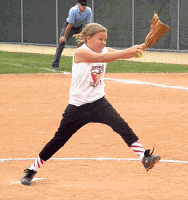
This
information is for those softball pitchers are PAST the
"beginner" stage... they have implemented the basic mechanics,
have developed good pitching speed, and have the control needed to
place the pitch where they want it. These recommendations
are from Colorado Pitching Instructor GERALD WARNER, and are based
on questions and E-mails received from visitors to this website.
Topics change and
are updated regularly, so re-visit www.pitchsoftball.com
often.
CURRENT TOPICS
FOR 1st AND 2nd
YEAR PITCHERS
The Basics...Grip, Stride, Arm Rotation,
Release
MECHANICS FIRST
– Learn, practice,
and develop good pitching mechanics first...do NOT worry about
throwing strikes when you are learning how to pitch. Learn how to do it right,
make certain that everything is correct and smooth, then
later you can start adding speed. Control
(throwing
strikes) should not be an
issue in the beginning.
First learn the correct way of doing the pitching motion and
delivery. Then LATER
you can work on being accurate and throwing strikes... (click here for full article)
Three
Essentials for Fast Pitches
There are three primary phases of the pitching sequence
that contribute to the speed and control of the pitch. These
are the common elements of virtually every high-velocity
pitcher. Many sequence
photos in this article were selected at random from an analysis of
pitchers... (click here for full
article)
11-Years Old - Does She REALLY Have a
Rise Ball?
It’s a great dream…a young pitcher throwing the
infamous rise ball.
Pitchers and their parents like to brag about how many
pitches they throw…even though all of them often look alike with no
movement at all. A true
rise ball is not merely a pitch that is released low and thrown to a
chin-high spot. We
discuss the correct spin
direction, the very fast spin
speed, and fast pitch
speed required for a “legitimate” rise
ball elsewhere on this website. In 20 years of training scores of pitchers of
all ages and observing thousands more we are yet to see a pre-teen
pitcher with a true “moving” rise ball... (click here for full article)
An Indoor Drill to
Increase Your Pitching Speed
We have found that the
most beneficial speed-increasing drill for softball pitchers is one
that can be done at home…and it is a simple one to set up. It involves hanging a
remnant piece of carpeting (or an old rug, or even a heavy tarp)
from a joist in the ceiling of a basement
or garage... (click here for full article)
How to Correct LOW (and INSIDE)
Pitches
Unintentionally throwing pitches
too LOW or low and INSIDE is usually attributable to a being
“off-plane” during the arm swing, the pitcher's closing rotation, or
when a pitcher strides too far off the power line (for
a right-hander, that means stepping left of the power
line) .
So when a pitcher throws pitches
inside...or inside and low...to a same-side batter, it is
likely one or more of the problems... (click here for full article)
How to Correct HIGH
Pitches
We receive many questions regarding control of
pitches…and one of the more frequent is correcting the
problem of consistently throwing high, or high and
outside. If that is your
problem, here is a list of several possible things that you can do
to become more accurate... (click here for full article)
For Increased Speed and
Accuracy - "Finish" the
Pitch
A
leaping-style pitcher must have a strong, fast push-off from
the pitching rubber in order to drive her stride leg out fast and
far. Then the
power, speed, and landing of the stride determines how effectively
the pitcher can push back against her stride leg to give her
the resistance for a hard final arm “whip” to throw the ball with
maximum speed... (click here for full article)
Recent Questions from Visitors to the
Site, & Our
Recommendations
Many of you who visit this site call or e-mail us with
your topics and questions. Click on this link to take you to
some of the recently-asked questions...and our answers.
click here
for all articles
We would appreciate hearing from you too, on
any question or recommendation relating to girls softball
pitching.
OUTDATED PITCHING RULES
NEED TO BE CHANGED - An opinion
The image and reputation of softball, not
just in the U.S. but around the world, has been tarnished by the
dramatic increase in the number of illegal pitch calls
recently, for the most part caused by the "leaping"
violation...not keeping the rear foot in contact with the ground
until the forward / stride foot lands. In many cases, the
calls were confusing to the pitcher, her coach, and in the case of
televised games, even the announcers... (click here for full
article)
Toe Drag...How to Correct the Leaping
Problem
Young
pitchers…and often even those with years of experience… can develop
a “leaping” problem.
Pitching rules (for girls and women) state
that a pitcher cannot become totally airborne during the pitching
sequence…at least one foot has to remain in contact with the ground
until the other foot lands.
click here
for full article
The Best Pitch Location - Low or
High?
We did an extensive 3-year study on the basic
subject of pitch placement and which locations resulted in the most
hits, and which resulted in 3rd
strikes. After
studying thousands of during-the-game pitches thrown by travel ball,
college, and high school pitchers, we now have some
statistics to support what many coaches and pitchers have always
emphasized. Here is a summary of
the results... (click here for full
article)
The Best Change-Up
"It doesn't matter if
you grip it with two fingers, four fingers, your knuckles, or your
elbow...the best change-up is one that looks like you are
throwing a fastball, then crosses the plate slow enough to mess up
the batter's timing." Here are brief descriptions of the basic
styles change-up. None is the "right"
one. Although most pitching instructors have a
favorite style, what is right for the instructor might not be right
for you... (click here for full
article)
How to Create a Striped
Ball
A striped softball is an
excellent tool to assist a pitcher with making certain that she
has (a) the correct rotation and (b) the maximum spin speed on
her breaking pitches. If you are highly intelligent,
have very good athleticism, and are skilled in freehand art, then
you too can create a striped softball. Otherwise, you can get
a 12-year old to do it for you. Seriously though, this is one of
the best tools for a pitcher who is constantly trying to improve her
drop, curve, screw, and rise balls.
(click here for full article)
What is an "Average"
Pitching Speed?
Pitchers,
parents, and coaches often ask what the typical pitching speed is
for a pitcher of a certain age. Since girl pitchers in
various communities and different regions of the U.S. have
different abilities and experience, and play at a variety of levels
of competition, there is not a specific answer that will work
for everyone... (click here for full
article)
Foot Placement on the Pitching
Rubber
We often receive questions
regarding where a pitcher must place her feet prior to the start of
the pitch, and during the pitching motion.Unfortunately, the rule for girl pitchers
can vary from one league to another, and even between the national
sanctioning organizations such as... (click here for full
article)
How to Stop the "Leaning Forward"
Problem
Every softball pitcher can pitch with better speed and
better control if she brings her shoulders back and “comes
back tall” as she releases the ball. Biomechanics studies
have shown that a pitcher will have maximum “torque”…and therefore
throw harder…if she does not lean forward as she finishes the
pitch.
(click here for full
article)
The
Drop Ball Part I - The "Peel"
Drop
Every serious softball pitcher needs to
develop an effective drop ball. A good drop can be an
effective "controlling" pitch…it keeps the batter worried, always
trying to guess what the pitcher is going to throw next. More
important, it is effective at creating swing-and-miss strikes… if
the ball drops several inches as it approaches the plate, the batter
generally swings above the ball. At the least, a good drop
causes the batter to hit only the top portion of the ball, resulting
in an infield ground ball... (click here
for full article)
"Stepping
Style" vs. "Leap-and-Drag" Pitching - Which is Best for
You?
There are
two fundamental styles of pitching in fastpitch softball…based
primarily on the aggressiveness and length of a pitcher's
stride (with her non-throwing side leg) . The
common names used for windmill pitching styles are
either "leap-and-drag" or "stepping style".
Neither is better...both styles of pitchers can be
taught to throw hard fastballs, good breaking pitches, and develop
good stamina.
(click here for
full
article)
Five Steps You Need to Take
to Become a Softball
Pitcher
We
have seen too many promising young pitchers ultimately get
frustrated, and in some cases quit pitching softball because they
were encouraged to do too much too quickly. Sometimes a
pitcher, a parent, or even a coach brags about how many pitches a
young pitcher can throw. Trying to learn new pitches before
you are doing the fundamentals correctly is a waste of time.
Learning to pitch takes a long time...with a lot of hard work and
practice... (click here for full
article)
Why
You Need a Good Change-up
Few softball pitchers, even those
with good speed, are able to overpower all batters with their
fastball. In time, some of the better hitters will be able to
time a fastball-only pitcher and start getting their bat on the
ball. The change-up offers a change-of-speed alternative, but
more important, it gives a pitcher an exceptional psychological tool
to keep batters guessing. A good deceptive change-up can
increase a pitcher’s effectiveness by more than 50%... (click here for full
article)
Warm-up Right - Pitch
Better
Warming up properly and completely…in practice or
before a game…is essential for good pitching performance.
Depending on the pitcher and the types of pitches she throws,
warm-up time varies from as little as 15-minutes to more than
1-hour. The better and more complete your pre-game
preparation, the better you will pitch... (click
here for full article)
What Pitches to Develop
Next
Develop a GOOD change-up pitch…then use it. The
speed of the change-up should be about ¾ the speed of your
fastball…at least 12-15 miles per hour slower.
We recommend that your third pitch is a drop ball. Finally,
you should learn to throw one more pitch that works...a curve, a
screwball... (click here for full
article)
Pitch Better by
Using the "Power Line"
The "Power
Line" (sometimes called the "Line of Force") is an imaginary line
from the center of the pitching rubber to the rear point of home
plate. Experience has shown that a majority of female
softball pitchers will be better balanced, AND will also have an
increase of pitching speed…with better accuracy…if the stride foot
touches against the power line when landing... (click here for full
article)
Other relevant articles on
this website
Increase the Speed of Your
Fastball
A Potentially
Dangerous Pitch Release...the "Over-the-Top"
Drop/Fastball
What Pitch
to Call...And
When
Recommended Products for
Pitchers
Does
a Rise Ball REALLY
Rise?
The Drop Ball Part II - The "Snapover"
Drop
Make Your Breaking
Pitches Break
Better
Crow Hopping and Foot Dragging
Rules
Every
Pitch...Even a Fastball...Has an
Arc
How to Select a Pitching
Instructor
Throw
Faster by Using a Good "Body Lean"
What REALLY is an Earned
Run?
If you have questions or need more
information
E-mail
us, or
call Pitching Instructor Gerald Warner in Colorado at (720)
200-4575
Home Page | | About Us
|
E-Mail Us
For Beginning
Pitchers | Advanced
Pitchers | Coaches and
Parents
|