|
Gerald
Warner, Softball Pitching Instructor
 
We want to hear from
you! E-mail or call us with any questions or
recommendations that you might have concerning girls fastpitch
softball pitching.
Here are some of
the questions we've received recently from other pitchers,
coaches, and parents:
Summarized
question from several parents, pitching instructors, and team
coaches
RECOMMENDED PITCH COUNT
"I see that many other coaches are often using the
same pitcher in back-to-back doubleheaders and tournament
games. My daughter is 13 and
is of average build. I don't want her to be doing
anything that could have negative consequences later in her
career. I've heard of young
girls being overused as pitchers and causing shoulder injury that
takes them out of the game for years. What should be a
recommended pitch count for one game, for a weekend tournament, or
per week?"
Certainly you have reason to be concerned.
Some overly-aggressive parents or even coaches push their kids too
hard in competitive sports, even to the extent of risking
injury that could have lifelong consequences.
Although the Little
League Softball organization and some local rec and
competitive leagues around the country establish limits for
pitching, the majority of them are based on
fairness...giving pitching time to all pitchers...not
necessarily as a need to prevent injury. As you
likely are aware, even though player safety is always a concern,
none of the largest national
softball sanctioning organizations have any
restrictions on number of pitches thrown.
As
you said, the underhand pitching motion holds considerably less
likelihood of injury UNLESS the pitcher's mechanics
are not good...even if they are off just a
little. Every time we track it, we always find that
the biggest causes of injuries to girl softball pitchers are
(1) incorrect mechanics and (2) overuse. So the potential
for injury is primarily based on each
girl's physical development, stamina, and the correctness of
her pitching motion. As you likely saw on my PitchSoftball.com
website, even some instructors are teaching pitches and releases to
young girls that can lead to injury. It only takes a few
snapping releases, twisting of the arm, "chicken wing" releases or
follow-throughs, bending forward at the release, etc. to start a bad
habit that could lead to chronic problems.
I am certainly not
recommending that a pitcher should be overused. However the
majority of developing pitchers at this age do practice
pitching 3 or more times a week for 45 minutes or so. And
in addition, in their ASA, USSSA, NAFA, etc.- sanctioned fastpitch
tournaments, it is not uncommon for a 14-and-under pitcher to
throw as many as 60 to 100 pitches in a game, 2 or 3
games in a day, 5 or more in a weekend tournament, without risk
of injury...PROVIDED she is doing things
right.
- GW
From T.N.,
CA
SIDE-STEPPING
"I have a question concerning staying in the
24" pitching lane. My daughter is twelve and does the side
step when pitching. She has to start on her far right with her
foot against the outside of the rubber to ensure she stays in the
lane. I would like her to have the right foot ON the far
side of the rubber to give her a better push off. How can I
best get her to work on staying in the lane?"
Talk with her pitching
instructor...likely s/he had a reason to teach her to side-step and
to not have her entire foot on the rubber. Typically an 8, 9,
or 10 year old beginner defaults to the side-step if she has a
problem with her opening and/or closing rotation. In your
daughter's case, my guess is that the extreme side-step is already
limiting...or at least soon will be...her pitch speed.
As you are
likely aware, depending on which local or national
organization(s) her team is playing under, most have rules
similar to the ASA and USSSA:
ASA:
Both feet must be on the ground within the 24-inch
length of the pitcher's plate.
USSSA: Both
feet must be on the ground within or partially within the 24-inch
length of the pitcher’s plate.
Regardless of the rule, your
daughter is losing the primary contributor to a quick drive off the
pitching rubber when she doesn't use the pitching rubber. We
always have a pitcher place the entire ball of her foot
on the front edge of the pitching rubber. That way, when she
pushes off she always drives against the rubber, and not
against loose or packed dirt, which may or may not be there
(because of the drag trench created by other
pitchers).
As you might have noticed in
college games this year, the NCAA is chalking the sides of the
pitching lane for each game...a 24-inch wide path from the pitching
rubber to the edge of the 8-foot circle. In your
daughter's practice sessions, you might do the same...use a chalk
line to lay down lines straight ahead from the sides of the
rubber.
For girls who are physically
capable of the straight-ahead power line stride, we have found that
those who side-step lose about 1 mph for each 2 or 3 inches they
land short of the power line. So a pitcher who falls short of
her power line by a foot is likely losing 4 or 5
mph. Check out this page on my website:
http://pitchsoftball.com/ThePowerLine.html
- GW
From C.F.,
WI
CONDITIONING AND WEIGHT
TRAINING
"My daughter is 15 and throwing mid 50's. What
are the best drills during the off season for her to pick
up 3 to 4 more MPH?"
Have your daughter focus on
work that will increase: (1) the explosiveness of her drive off the
pitching rubber, and (2) the speed of her final "arm whip" going
down to, and through, the release of the ball.
Speed training with a
harness and resistance band is a great way to build up leg muscles
and consequently body speed off the rubber. An
inxpensive ($25 or so) speed harness system is available from World
Sport, Inc. on their website: www.worldsportusa.com, and Amazon.com and
e-Bay.
Previously on my website, I
responded to a question about what areas to target with weight
training:
Shoulder (pectorals
in particular)
...don't focus on bicep...the pec is THE muscle used for arm
whip
Wrist and
hand (for
pitches that she will be working on in the future that will
require wrist snap or peel)
Core
muscles (abs and
lower back) for
trunk opening and closing rotation
Legs
(for an
explosive drive off the pitching rubber, and for a strong front side
at the release)
If your daughter is in a
weight-training class in high school, the trainer there (or one at a
local fitness center) can help her with a program for (a) her pecs,
(b) wrist and forearm, and (c) core muscles.
Also, the
"pitch-into-a-hanging-rug" drill that I mentioned on the website has
alone helped a lot of high school-age pitchers pick up the 3 or 4
mph that you are looking for. Here is a link directly to
that page:
http://pitchsoftball.com/DrilltoIncreaseSpeed.html
Finally, a lot of pitchers, even
many with 6 or 8 years of experience don't finish their fastest
pitch with a good "front wall resistance" from their landing
leg. Have your daughter look over the information here to make
certain that she is getting a good pushback:
http://pitchsoftball.com/ForMoreSpeed-FinishthePitch.html
It will help if you
video 2 or 3 of her pitches from her throwing side to use the
comparison of the photos in the article vs. the frame-by-frame
example that you get from the video. -
GW
From Miranda, 17,
Sacramento, CA
"My pitching coach
taught be to throw a rise ball 2 years ago, but it doesn't spin in
the direction that you show on your website, and it doesn't really
move. And she tells me to keep my weight forward, not
back. Do you have any pictures of someone releasing a rise
ball with a good form?"
Sure, these should help:
 
 
This is a pretty "classic" release:
weight back, shoulders open, short follow through straight
up. -
GW
From D.M.
CURVE
BALL - "What is the most effective curveball
grip and any other points to really focus on for success with this
pitch?"
Like with
other breaking pitches, the curve is far more dependent on the
timing and intensity of the wrist snap at the release than it is
with the grip. Although we typically like to see a
4-seam side-to-side rotation on the ball, some pitchers feel more
comfortable with what results in a 2-seam rotation and they still
get a good break.
In general, men often have
good success with a palm down release (it requires
exceptional wrist strength and flexibility) ; girls and
women are most often successful with a palm-up,
fingers-up release with a release and follow-through
side-to-side across the pitchers
abdomen.
I generally encourage most pitchers
to start with a 3-finger grip that allows two fingers to be placed
against the sides of seam ridges. Put your index
and ring fingers against the sides of the U-shaped seams...the
middle finger therefore can rest at the top of the U, or on smooth
leather. By gripping it that way, those two fingers then
drive against the side of the stitches at the release to give the
ball a tighter spin. Otherwise, for a 2-seam grip,
put the middle and ring fingers against the stitch ridges on the
"narrows" where the seams are closest together...the index finger
can lay loose against the side of the ball.
The
effectiveness of the curve is going to be determined not by which
grip is used, but by the direction and speed of the
spin. Ideally we would like to see a side-to-side
spin (going in the direction of the curve, as seen by
the catcher) , but often end up with a sideways rotation that
also angles downward. For a palm-down curve, the hand
must "snap" around the outside of the ball precisely at the release
point. For the more common fingers-up, palm-up release,
the fingers need to be pointing skyward at the approach, and the
wrist snap needs to be short and quick across the waist or slightly
below it. Often, bending your trunk backwards at the release
helps to achieve the fingers-up position. Otherwise, if
the fingers are bent slightly forward at the release, it results in
a screwball spin...opposite of what you want to
achieve.
Finally, with either
style, a stride substantially across the power line can help with
both spin speed and pitch placement. So a right-hander,
that means stepping up to a foot to the right of the power
line, and pitching around the left
leg.
-
GW
From K.Y.
-
Please give me some information on the effects of the
rotation of a softball, and the release of a pitch and how it can
affect a pitcher's speed.
The rotation of the
ball...the spin that a pitcher imparts at the release of the
pitch...obviously has an effect on the direction that a pitch
breaks. However, the spin does not have any noticeable
effect on the speed of the pitch. Pitch speed is
a product of the speed of the pitcher's arm coming through the
release point, and the added speed that correct wrist position and
the wrist's forward movement (wrist snap) at the precise moment the
ball is leaving the pitcher's hand.
SPEED
- The pitcher's arm speed must have reached its maximum
at the exact point of the release of the ball. Consequently,
although arm speed should be fast through the first 2-thirds of the
arm rotation, a pitcher must further increase arm speed during the
final 120 degrees during the final arm swing and through the release
point.
Additionally, correct
position of the pitcher's wrist at the release point is essential to
obtain maximum speed. A thumb-first release with the
fingers behind the ball, driving it through the release, is proven
to be the way a pitcher can achieve the best
speed. Simultaneously, a forward wrist snap
(straight ahead, without twisting the hand over the top or around
the outside of the ball) can add an estimated 3 to 5 mph to the
pitch. Pitchers who use an over-the-top drop ball
release on their fastball can lose much of the speed increase that
comes from a forward wrist snap.
ROTATION OF THE BALL
and THE "MAGNUS EFFECT" - The direction AND speed of
a ball's spin determine the effectiveness of "breaking" pitches in
softball (drop, screw ball, curve, rise ball, etc.) . If
the ball doesn't spin in the right direction OR doesn't spin fast
enough, it won't have the intended drop, curve, or rise
effect.
The ability of a spinning
projectile to curve (up, down, or sideways) in
flight is caused by the Magnus
Effect. It can best be demonstrated by using a
lightweight table tennis ball to impart spin...even backspin...to
cause it to actually rise in flight. As a ping pong ball or a
standard weight softball spins in flight, a slight vacuum is created
on the side, top, or bottom of the ball. For instance a
correctly spinning "rise ball" must have a true backspin (rapidly rotating bottom-to-top as seen by the
catcher) to create a slight vacuum on the top side of the
ball, giving it an extended lift in flight. Although a
true rise ball in softball does not make an upward banana-shaped
trajectory as many people think, a fast spin in the correct
direction can cause it to stay in flight longer, and therefore have
a more level path instead of the natural downward arc of even a 65
mph fastball without the same spin. Similarly a curve
ball must spin rapidly in a side-to-side direction, a drop ball in a
top-to-bottom direction (as seen by the
catcher), etc.
It is estimated that a drop
ball needs to be spinning in the correct direction at a speed of
at least 16 to 18 rps (revolutions per second) in order to
have even a minimal drop due to a correct release.
Similarly, curve balls and screwballs must spin
faster...more than 20 rps. And a true
rise ball must be spinning in excess of 25 rps in
order to stay above the normal parabolic arc of a slower-spinning
fastball. Most softball pitchers who "think" they can throw a
rise ball do not impart a correct reverse spin on the ball and/or do
not have a hard enough wrist snap at the release to make the pitch
work
properly.
-
GW
From a
concerned parent:
My daughter does an over the head windup,
and then explodes off the mound. In high school this
year the coaches like her but want her to stop doing the overhead
windup. My question is why do they want to cut her windup when she
is comfortable doing it that way?
I'm not certain why
anyone should be concerned about your daughter's over-the-head
pre-pump at the start of her pitching motion...there are probably a
lot more important things to be concerned with.
Yes, we encourage new young pitchers to "keep it
simple" by starting with their pitching hand and glove together in
front of their body and then going into their backswing, before
starting the forward rotation. However, like your
daughter, most teenage pitchers like to introduce something into
their pre-motion that is her "trademark"...something that makes her
look different, and maybe even a little more
intimidating. And some major college pitchers
and even a few big-name Team USA pitchers do your
daughter's "scare-the-bear" overhead move prior to starting
their
backswing:
 
It
doesn't help, but it also doesn't hurt as long as it doesn't affect
her timing. Typically, whatever a pitcher does before she
starts the forward rotation does not have anything to
do with pitching speed or
accuracy.
-
GW
From
S.K.
My daughter just turned 12 and pitches for a 12U
ASA travel team in California. She is a lefty but not a
large girl (5feet) tall and throws her fastball generally in the mid
to high 40s. My question relates to the fact that
she uses a slow drop curve as her change up. She learned
it from a UCLA pitcher last summer and is very comfortable with
it. I have taught her to pitch from watching videos and she
has had some intruction at UCLA. In order to take her to the
next level we are trying to find her a pitching coach. The
person who worked with her yesterday immediately wanted to convert
her to a more traditional change up. He also wanted her
to learn the rise ball but I dont think she is big enough or throws
hard enough yet. What do you think?
Good
questions.
(1) RISE
BALL - First, let me go on a rant about teaching a 12-year old a
rise ball. Because this is a very difficult pitch to
learn, develop, and perfect, we typically don't have pitchers even
start to work on a rise until they have gone through their
major growth spurt...usually in their mid-to-late teens...and
have a pitching speed at least in the 55-58 mph
range. Despite all of the bragging you hear from young
pitchers, parents, coaches, and pitching instructors, most of the
true rise-ball college-level pitchers didn't develop their
rise until they were in late high school or college.
There's far more for your daughter to be working on at this age than
a pitch release that doesn't have any meaningful effect on a batter
other than to provide a sweet floating fastball through the power
part of the zone. Teaching a rise ball release to her
during these pre-teen growth-plate injury prone years is a risk that
is not worth taking.
(2) OFF-SPEED DROP/CURVE - Without question a
low-and-away breaking pitch (curve, drop, or
drop/curve) thrown off-speed should be your daughter's "take
charge" pitch...the one that she can go to at any time to mess up a
batter's timing. However, I would recommend a
traditional change-up (either the back-of-the-hand
"flip" release, or the stiff-wrist "open palm" method) as her
slowest (25% to 33% slower than her fastball)
pitch. Over the next few years she is going to face
more skilled batters, many of whom can reload for a change, and that
requires a pitch that comes in at a speed between the fastball and
change-up. And THAT is where I would suggest that she
puts the off-speed drop/curve. Even in a few months,
just those three pitches can be a great repertoire: 50mph
fastball, 33mph change-up, 41mph off-speed drop/curve.
Then, if things go on schedule, in two or three years, she can aim
for speeds of 60, 39, and
48.
-
GW
From
M.C.
I have a
10 year old left handed pitcher, should she be holding the ball with
all fingers right now or go ahead and get use to holding with as
little as possible. Also, how many different pitches should she have
right now?
GRIP - HOW MANY
FINGERS?
Most girl softball pitchers use a 3-finger grip for their
fastball and later, for most of their breaking pitches.
Since your 10-year old is likely using a slightly smaller 11-inch
ball (the standard 12-inch circumference ball is used by most
organizations for ages 11 and over), it would be beneficial for her
to try a 3-finger grip (4 if necessary to get started), and then
stick with a 3-finger grip as she graduates to the standard-sized
ball. Also, it is best to start with a grip that places the
pads of the fingers on the side of the 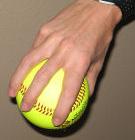 horseshoe (or "U") seams on the ball, like in
this photo: horseshoe (or "U") seams on the ball, like in
this photo:
This type of
grip is called a "4 seam" because when it is pitched, the ball
will rotate top-to-bottom (as seen by the catcher) with all
4-seams digging into the air. It is a more sure grip
because of the traction on the stitches of the ball, and also
prepares the pitcher for future
pitches.
HOW MANY
DIFFERENT PITCHES?
This
is a very important topic. The bottom line is
DON'T LET YOUR PITCHER FEEL LIKE SHE HAS TO BE ABLE TO THROW A LOT
OF DIFFERENT PITCHES to be successful.
There is a lot of peer pressure put on
young pitchers, sometimes by other girl and sometimes by adults, to
try to have a repertoire of several pitches. Don't fall into
that trap. We have seen hundreds of pitchers brag about their
5 or 6 different pitches...BUT THEN, when they throw them all of the
pitches look alike...none of them drop, curve, rise, etc.
10, 11, and 12-year old girls cannot throw a "rise ball", and
the majority who think they have a curve or screw ball aren't really
throwing a really good breaking pitch. Most
pre-teens also risk injury if they try to throw too many pitches
that require a hard wrist snap, so we discourage our pitching
students from working on a curve ball, a rollover drop, or screw
ball until their growth and athleticism can safely accommodate
the type of wrist snap that is required. And the
majority of pitchers who start development of a rise ball too soon
never successfully throw one.
At age 10 most pitchers should work
on correct (straight stride, no bending at the waist on the release,
etc.) and smooth pitching mechanics. Then, as
mechanics develop correctly, and as she develops a more natural
fluid motion, start adding speed. Then,
when mechanics and speed are good, THEN work on
placement...hitting her spots. Then, work on a
good, deceptive (without a noticeable slow-down of
body motion or arm speed) change-up that is 25% to 33% slower
than her fastball. 10 and 11 year old pitchers can
be very successful with good speed, being able to "hit the corners",
and keeping the batter apprehensive with her change-up. THEN,
after those things are all working well...sometime between
ages 10 and 12...start working on a "peel / lift-up" type of drop
ball...which is a lot less risky for a pre-teen than the
rollover/snapover drop ball. We have developed many good
high school age pitchers who relied primarily on their
fastball, change-up, and full-speed and off-speed drop
balls. A curve, screw, or rise ball can come
after...and only after...everything else is working
well.
-
GW
From
D.L.
I have
coached various sports in the past couple of years, and I would like
to start coaching softball I have no prior experience playing the
game; so that makes it a little intimidating for me. I would really
like to focus on being a pitching coach (and
make sure that none of the pitchers get bad advice that could
shorten their career).
If you could give me any
thoughts on how to get started I would greatly appreciate
them.
As you saw on my website, I and most other
pitching instructors always have our young pitchers work on good
mechanics...pushoff, fluid arm swing, opening and closing trunk
rotation, stride and landing, arm whip, release, and
follow-through. Once the fundamental
mechanics are in order (and for some it can take months, or even
more than a year) THEN speed and control will not be an
issue.
So I
would first recommend that you become a real student of girls'
windmill pitching mechanics. Get some input from one or
two of the good pitching instructors in your area, talk with
some college and local high school pitchers to get feedback on what
they have been taught right and wrong, and how their
experience and recommendations apply to your
girls.
There is an excellent
book that I mentioned on my website, FastPitch Softball, the Windmill Pitcher
by Barry Sammons. It is probably the
best resource available on girls pitching. You can pick it up
online through Amazon.com or E-Bay....should be $15 or
so. Also, videotapes by Cheri Kempf or Michelle
Smith could be very
helpful.
-
GW
- From
T.B.
I am 17 and I'm a junior
at High School. I am a right-handed pitcher and throw between
57-60 MPH. I have a fast-ball that I can pretty much
hit any location, an off-speed that isn't always perfect but is a
great pitch, a change up that is slower than my off-speed and has
a spin to it (the only bad thing is that a good batter will be
able to wait on it), and my screw ball which is pretty affective.
Are those good pitches or do I need to work on a rise ball also? I
want to gain some velocity in my fastball but I'm not really sure
how I should go about doing that, any advice? Do you have any
information about what colleges are looking for in a
pitcher?
What you are
asking really depends on the level of competition that you are
facing...both in high school and in competitive travel ball...and
also what your plans might be for playing in
college.
- PITCHING SPEED - Your high 50's speed is good, but speed is a place
where every pitcher can stand out...if she is willing to work at
it. Depending on your physical size and strength, you
can likely pick up a few miles per hour with only slight
modifications in your pitching mechanics, and especially
emphasizing the "arm whip" (putting all of your effort into the
final downswing going into the release) and a final forward wrist
snap precisely as the ball leaves your hand.
If you aren't on a weight training program right now,
get busy on developing your throwing arm shoulder
(pectoralis muscle), your wrist and fingers,
and core (abs and lower back) . All of
these areas contribute directly to pitch
velocity. For other possibilities, take another
look at the page on my website "Increase the Speed of Your
Fastball".
-
DROP BALL
- You mentioned that you had an
off-speed and change-up, and a screw ball. If you
don't have one, a good drop ball is an essential
pitch to have. Get advice from your pitching
instructor, but typically an "over the top" snapover drop is best
for a pitcher with your experience. You can succeed in
high school with good fastball speed, a deceptive change-up that
is 30% or so slower than your fastball, and a good drop ball
(perhaps thrown at a speed halfway between your fastball and
change) . Your screw ball is icing on the
cake.
-
RISE BALL - As you
likely read on our website, most pitchers work on developing a
rise at your age, but often don't get it developed until they are
in college. If you plan on playing serious Gold-level
competitive softball and/or continuing your pitching after high
school, a rise ball is important. Yes, start working
on it now, but be prepared for a lot of hard work to get it
spinning in the right direction, and at a fast enough
spin speed to make it climb above the normal plane of a
regular fastball.
Finally, all college
coaches are looking for pitchers. Pitchers, catchers,
good shortstops, and hitters with high batting averages get first
opportunities on whatever athletic scholarships colleges might have
available.
-
GW
From S.B.
My daughter is a 12 year old, 7th
grader, who has been pitching, with a coach, for the past 2
years. She has grown into a very fine pitcher. Our
problem is that she her school coaches think she is a machine and
not a 12 year old girl.... She has worked very hard, in
spite of playing three sports. Her school coaches very seldom
congratulate her on pitching a good game, but are critical when her
pitching is less than perfect. My husband and I are concerned
that the stress will wear her out, and she will give up on
pitching. We as parents and coaches need to understand
that young children can produce so much more when encouraged rather
than discouraged.
Well said...and you have a
reason to be concerned. Nearly 90% of the younger kids
who participate in recreational and competitive sports quit before
playing the game in high school...and a significant majority of them
give it up because they get more reprimands for their mistakes than
they get accolades for doing things
right.
A
couple of the big business gurus 20 years ago were Tom Peters (In
Search of Excellence) and Ken Blanchard (The One Minute
Manager) . Both claimed than Supervisors and
Managers got better results from their subordinates if they set a
goal of "...always catching them doing something
right." And Blanchard and his cohort Bob Waterman
based their "One Minute Manager" series on a child psychologist's
recommendations to focus on the behavior rather than the child, to
limit reprimands to 60-seconds, and to focus on the praises for
doing things right.
Coaches have a
responsibility to be counselors...not reprimanders; and that
girls are different from boys; and that we all work harder
when you tell us when we have done something
right. -
GW
From R.W.
I
just read some of the answered questions on your web site. One was from Kelli in Ohio
simply thanking you for recommending a technique for the "arm
whip" to her instructor. Tell me more.
A
majority of girl softball pitchers don't reach their
fastest potential pitching speed because they haven't concentrated
on increasing their arm speed on the downside swing approaching the
release point. We pitching instructors typically encourage new
young pitchers to develop a "smooth and consistent arm
rotation". All too often however, we fail to
take them to the next step when they are ready. And that
is to develop a faster "arm whip" during the final one-third of the
rotation.
 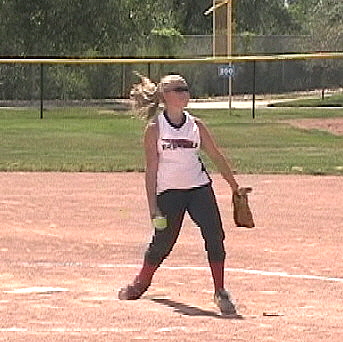
Focus on increasing arm speed
from
HERE
to HERE
The best drill to practice
this is for the pitcher to line up from 25-or-30-feet from the
catcher, and line up sideways to the catcher in the "9 o'clock
position" (similar to the pitcher's open position in
the first photo...pitching hand straight up, glove pointing toward
the catcher), then pitch from that position...close fully,
and follow-through in your normal fashion. Concentrate
totally on fast arm speed from the 9 o'clock position through
the release point.
Most pitchers can
develop a faster fastball if they have their wrist bent back
slightly going toward the release of the ball, and focus more on
their arm whip. Arm speed will be faster, wrist snap will be
better, and her pitching velocity will
increase.
-
GW
_______________________________________________________________________
From B.K.
My daughter is 16
and is a fastball pitcher. I have heard that they should
not learn to throw a rise ball until they are 17
or 18. Is this true and what is the
reasoning for it?
As you likely read on this
website, although most high school-age pitchers like to think
that they are throwing a rise ball, most aren't. This is
a pitch that requires exceptional mechanics and a precise
release to get the ball spinning in the right direction and
at a sufficient rotation speed (in excess
of 20 revolutions per second)...and at a speed at least in the
high 50's.
Therefore, we
always hold a pitcher back from even starting to work on the
rise ball until she :
(1) has
gone through her early-teens growth spurt
(2) has
gained some additional athleticism
(3) will
make the long-range commitment to work hard on properly developing
the pitch.
And those
are the primary criteria that I would recommend for your
daughter...don't rely on her age to determine when to start working
on a rise.
Although
there are certainly a lot of high school and travel ball pitchers in
their mid-teens who are successfully throwing a rise ball, the
percentage is in the very low single digits. In general,
most teenage pitchers start working on a rise ball while they are in
high school, but typically don't perfect it until they are in
college. -
GW
From R.S.
I am
wondering what position the pitcher should be facing when she
releases the ball, facing the third base, or facing the
batter? We have had
a discussion and many feel that she should be facing the third base,
but I don’t see how she could get a good release of the ball.
It goes to the left of the plate all the time, because she has to
throw around her body.
This is a problem that
is not only one for coaches and parents, but also an issue that
could result in injury to the pitcher if done
wrong.
Our strong recommendation is that you
should make certain that pitchers do neither. (1)
If a pitcher's trunk and hips are fully "closed" (facing home plate)
at the precise instant the pitch is being released, she gets very
little velocity in her pitch...the closing rotation which
contributes to the speed of the final arm swing is already completed
by the time she releases. (2) The "open" style (where a
right-handed pitcher's body is facing 3rd base, or sideways to the
catcher) is being taught by some pitching instructors nationally,
but we recommend against it. Younger, and even
high-school age girls of average size can easily incorporate a
slight bend at the waist into the open release, which can lead to
lower back problems.
The MAJORITY of successful pitchers
release the ball with (1) their hips approximately
halfway (or slightly less) closed, and their
shoulders nearly fully closed (facing the catcher)
. Here is an example:

This is for the
fastball release only...other pitches require different
shoulder and hip placement at the release
point.
Below is an example of the "open" style of release
(which we permit ONLY to be used by older, larger
pitchers on the release of their RISE ball)
...you can likely see how it bending at the waist while in
this sideways release position can lead to lower-back problems with
some girls:

From J.M.
My daughter is 11 and has great desire to
become a pitcher. She has worked with a pitching coach for 10 months
now and has showed flashes of great pitches. Speed is there but
control is not to good. She may throw 3 to 4 good pitches and then
throw five or six like she never touched the ball. We practice
pitching every other day, about fifty pitches at a time. I thought
by this time her control would be improving. Am I expecting too much
too soon? We seem to have hit a wall where I am not seeing any
improvement. Her coach says keep working and doing the drills. Any
advice?
It
sounds like your daughter is right on the borderline...usually after
6 months or a year of practicing good pitching mechanics, and then
adding speed, the control issue becomes a virtual
automatic. We always have a student focus on
fundamentals...good mechanics. Then when things are
starting to become smooth and routine, add in the speed
element. We don't generally start focusing specifically
on placement until all of that is going well.
Without seeing her in person or on video, it is obviously pretty
difficult for me to make even a moderately accurate
assessment. Here are some thoughts and
recommendations:
(1) In your practices with
her, and if she pitches in games, it is really beneficial if the
coaches, parents, teammates, etc. don't fall into the trap of
telling her to "JUST THROW STRIKES". She knows the
objective, and such statements just make a pitcher nervous...she
starts trying to satisfy the crowd, forgets the pitching mechanics
she has been working on, and starts leaning over on every pitch
trying to "aim" the ball across the plate.
(2) If you are
confident that her pitching coach is teaching her the right
fundamentals (straight ahead stride, shoulders back
/no waist bend at the release, focus on throwing straight ahead
right down the power line, etc.) then continue working on
the mechanics. Too many drills without focusing on
one-pitch-at-a-time pitching can often be detrimental.
If you daughter can learn pre-pitch visualization (mentally
visualizing the trajectory of the ball before she throws it...that
often helps even at her young age. Her instructor
might have already introduced her to "focus point"
preparation...where she is staring prior to starting her pitching
motion. But the real problem with out-of-the-zone
pitches likely is related to something she is doing wrong
mechanically.
(3) In your practice
sessions with her, whenever possible have a girl her own age catch
for her. Nothing wrong with you, but she needs to get
accustomed to throwing to a short catcher.
(4) Instead of
counting the number of practice pitches...go for a specific period
of time. At this age, 45 minutes of practice pitching
3 (or 4) times per week is about the maximum that she can tolerate
without burning out. That way she can concentrate on
each pitch...determine for herself what she did right or wrong,
and then make the correction on the next pitch if necessary.
Otherwise, if an 11-year old knows that she has to go out and
throw 50 pitches and then she can quit, she might not put her
heart into working on each pitch. Let her make the
decision...if you have to tell her it's time to practice, things
won't go well.
(5) Help make pitching
fun for her. She knows when she does something wrong,
and most of the time doesn't have to be told about it.
Try to catch her doing things right, and let her know when she
does. This is a sport...she needs to WANT to do it,
and HAVE FUN doing it.
Sorry if
some of this might sound a little like a lecture, but we always see
that kids who are stressed or tight don't perform well.
A loose muscle is a fast muscle. Tight muscles cause
control problems for pitchers. Stay loose, stay happy,
stay confident, and pitching can be
great.
-
GW
From Tom W.
My
Granddaughter is 16 and started throwing a curve this past summer.
She is right handed. She is able to throw it quite well to the
out side of the plate for right hand batters but when she tries to
throw it to the inside of the plate it doesn't break. We think
her problem is that she shortens her wrist snap to keep the pitch to
her
right.
It sounds like you have
pretty well diagnosed what is going on.
When the curve works to
the left side but not to the right, there is usually one of two
things causing the problem, and either can usually be corrected by
adjusting where the left foot lands on the stride. (1)
Some pitchers are "side-steppers"...such as a
right-hander whose stride-leg steps several inches...maybe
even a foot to the LEFT of the power line. (2) Even some
straight-ahead steppers don't change their stride when they throw
either a screw ball or a curve.
A right-hander throwing a
screw ball can usually make the pitch more effective
if she side-steps to the LEFT.
Similarly, most really good right-handed curve ballers can benefit
by stepping (with her left foot) to the RIGHT of the power line
when they stride.
Obviously,
any change in the delivery will take a little
getting-used-to. But have your Granddaughter try:
(1) landing her stride foot about 6 inches
to the RIGHT of the power line when she throws the
curve. This creates a subconscious image that she has to
throw the pitch "around" her left leg, and forces her to impart a
better snap. (2) Also, for a
pre-delivery "focus point" prior to starting her wind-up, have her
focus somewhere on the batter's thigh (if SHE
thinks it is going toward the batter's leg, so will the
batter). -
GW
From Kim,
Kansas
I just turned 11
years old and have a pretty good fastball (my coach says it
is about 48 miles an hour) and a flip-type change that
works most of the time. Those are my only two
pitches. Some of the other pitchers my age have a lot of
pitches...one of them says she throws SEVEN different pitches, and
she is only 11 also! My coach says I shouldn't start on new
pitches just yet. I'm feeling like a loser.
Do you have any advice?
I sure do! As a pitching
instructor I regularly hear from pitchers or their parents who brag
that they have a lot of pitches. But when I have them
pitch, everything looks the same...sometimes there isn't even any
difference between the speed of the fastball and the
change-up. Just because a pitcher learns the grip of a
pitch doesn't mean that she is throwing it with the right spin or
the right speed and with good control.
A drop ball
isn't a drop ball if it doesn't drop; a curve ball needs to
curve; and a rise ball needs to actually hop up over the
bat...not just a pitch that is thrown from the knee and crosses the
plate
high.
It is MUCH better to
throw two or three pitches really well, than to have 5 or 6 that
don't do anything. Follow your coach's advice: (1)
Get your fastball going faster...with good mechanics...and with good
control; (2) Make your change-up look really deceptive...just
like a fastball...but at a speed about 15 miles per hour
slower; (3) THEN start working on your first breaking pitch,
probably a drop ball. If you're going to be a really
good pitcher, each one of your pitches has to work well.
Take your time to develop each pitch right and don't fall into the
trap of trying to follow the
braggers. -
GW
From Kanysha,
Georgia
My coach wants me
to slow down the speed of my change up pitch, but he also says it
should be more level...without a "hump" in it. Do you have any
advice on how to throw a change up in a straight line like a fast
ball, but a lot slower.
Thanks for bringing this up again. I recently had
a similar question from the father of one of my students, and a
follow-up to some work we had done a few years ago on change-up
speed and the "parabolic arc" it must follow. We have seen
that a majority of pitchers throw their change too fast...presumably
because they are trying to "keep it level." (1) Deceptiveness
and (2) off-speed are the two major components of a
change-up. We recommend that the speed of a change be
25% to 35% slower than a fast ball. For most
pitchers, that means that the "high point" in the arc of a change-up
will be somewhere around letter (chest) high
(or for younger pitchers with a slower fast ball, the
arc of a change could go to as high as equal to the batter's
shoulders).
For more, including some diagrams of the
result of the study that we did with the assistance of two
university instructors, see this page: All
Pitches...Even a Fastball...Have an
Arc -
GW
From
S.R.
As high school coach I have problems with some
Summer League coaches who alter the pitcher's delivery or batting
stance and bunting techniques that have been successful . Many
of the things they tell the kids are not the best technique...Some
of the coaches are parents, so I don't want start a feud in the
ranks. Any suggestions?
Your problem is a pretty common one. I
hear from a lot of good knowledgeable coaches who have a problem
with their players getting the wrong advice from well-meaning
parents or coaches. Personally, I hear it consistently
when one of my pitching students tells me that her team coach wants
her to bend at the waist when she releases the ball, or "always keep
your body straight ahead...never rotate sideways". Some
parents obviously feel they should be always be saying
something to their daughter...even if it might be
wrong.
I
certainly don't have an easy answer. With pitchers, I do my best to
educate parents at the same time I teach their daughter.
If they hear enough of the right things, they will be less likely to
give wrong advice. With your team's success with state titles and a 4 to 1
win-loss ratio, you should have a heck of a lot of credibility with
parents and the coaches of local Summer teams. So my
recommendation would be to take advantage of it:
- Organize a
1-day clinic for pitchers...invite parents to come and listen
in.
- Do the same
thing for hitting.
- Have parents
attend one of your team practices where you and your
Assistant(s) reinforce some of the specific fundamentals that
they might be giving wrong advice about.
- Promote good
coaching clinics that might come to your area...like Mary
Nutter's National Sports Clinics for coaches.
- Make available books and videos from
nationally-recognize hitting and pitching coaches that reinforce
what you teach. (I like Barry Sammons'
FastPitch Softball, the Windmill Pitcher, or Cheri
Kempf's The Softball Pitching Edge books for pitching
technique)
Rather than
confronting the giver-of-wrong-advice directly, you can also feel
free to refer them to me...provided it is about
pitching. As you can see from my website, I am very
strong on fundamentals, so likely you and I would be saying the same
thing.
It would be
great if one day we had educational requirements for coaches and
parents in all sports...requiring them to have the correct knowledge
before they could give advice. That probably won't
happen
however. -
GW
From
TC, Illinois
"My
friends and I have been debating the following situation and whether
or not the runs are considered earned or
unearned?:
Situation: Let's say that there is two outs
with nobody on. The batter gets on by an error.
Hypothetically, let's say the next three batters hit home runs, thus
making the score 4-0. Is the pitchers ERA 0 or 3?"
Good
question. Most coaches and
scorekeepers would have automatically given the situation 3 earned
runs without giving it additional thought.
However, under typical softball/baseball scoring
situations, they would (or at least SHOULD) be
wrong. Whenever a fielding error occurs, the pitcher shall be
given the benefit of the doubt in determining to which bases any
runners would have advanced had the fielding of the defensive team
been errorless. Since the error should have resulted in
the final out of the inning, the subsequent homers should NOT
be count as earned runs. Check out Section 10.18 of The
Official Online Rulebook for Major League Baseball at:
www.mlb.com/NASApp/mlb/mlb/official_info/official_rules/official_scorer_10.jsp
Here is an
additional interpretation from The Baseball Archive
at www.baseball1.com/ :
Rule 10:18 - An earned run is
charged every time a runner reached home base by safe hits, sacrifice
bunts, sacrifice flies,
stolen bases, putouts, fielder's
choices, bases on balls,
hit batters, balks or wild pitches
before "fielding chances
have been offered to put out the offensive team".
"This last clause means, basically,
putouts plus errors, the idea being that the pitcher
should not be held responsible for runs scoring after (e.g.)
an error which should have been the third
out".
- GW
From Carl, a
parent
"My daughter took and year off, and has
now made it to the "B" nationals. I have recently noticed that
her fast ball is coming in kind of like a screwball and you can see
a dot on the spin as it comes in. Her fast ball is now much
slower, and her accuracy has suffered. It appears that she is
rolling off the inside part of the ball with her fingers, and not
staying behind the ball. She has small hands and says she is
gripping the ball the same way she always has. Is there a grip
we can try to see if she can keep her fingers behind the
ball?"
And a similar
question from Roger, Illinois
"I
have a 7 (almost 8) year-old daughter playing
fast pitch softball. She practices pitching and hitting
usually at least 3 nights a week. I started her out just throwing as
a pitcher would and after about a week she has somewhere out of no
where come up with a twist of her wrist (not a flick, a twist) where
it came from i have no clue.. but she pitches better when she does
it... if she pitches with the
twist it is usually a good
hard pitch, with some speed and she has varying control. Is this
twist normal or can it hurt her?
You have a good question. Often we see a young
pitcher...especially one who has not yet developed wrist and
arm strength... twist her wrist at the release of the
ball. For a right hander, the twist is a
clockwise twist...for a lefty, just the reverse. If you
are a bowler, this is similar to what is often called a "back-up"
ball. Right-handed bowlers with weak wrists (my wife is one of them) release the bowling ball with
a backwards rotation, causing it to curve to the right.
Although there is a big difference between a 6 oz. softball and a 14
pound bowling ball, the concept is the
same.
We often run into the problem with
older pitchers who are developing a screwball (the one that curves
opposite from a traditional curve ball). The screwball
requires this sort of clockwise twist release, and when practiced
too much, can actually drift over into the release of the
regular fastball (which requires the fingers to be directly behind
the ball at the release point). We had one pitcher who had
learned a screwball from her previous instructor, and it took nearly
two months to get her to release the fastball
properly.
Although I suspect that a twist
release could eventually lead to wrist, forearm, or elbow problems,
I have not read any biomechanics studies on that specific
problem. Nonetheless, it would be a good idea for your
daughter to break the habit now, while she is just starting
out, and start throwing with the good mechanics that will be
necessary to her pitching in the future.
A
natural underhanded release of the ball requires the inside
of the wrist to lead the way...driving it right down the power line
toward the catcher. The 3 or 4 fingers holding the ball
are therefore on the back side of the ball, providing power
to drive it through at top speed, which is lost on a twist
release. Eventually (but don't work on it just yet),
your daughter will consciously add a forward wrist snap at the
release of the ball, adding a few additional mph. With
the inside of the wrist going first, and the fingers behind the ball
as the ball leaves her hand, your daughter should work on a good
"follow-through", being careful to NOT snap the ball by stopping her
arm movement at her hip. Stopping or snapping at the hip
can cause injuries. After the ball is released, she should
allow her arm to continue forward...sort of a free
movement...letting it go wherever it wants to go. Typically, a
good follow-through will let the arm bend AFTER releasing the pitch,
then swing straight ahead bending upward. Some pitchers end up
with their fingers coming up and touching their pitching
shoulder.
If you are
willing to spring for the $15 or $20, I would suggest that you pick
up one of the books we mentioned elsewhere on
this website: (1)
Barry Sammons'
FastPitch Softball, the Windmill Pitcher,
(2) Cheri Kempf's The Softball Pitching
Edge, and (3) The Complete Book of
Pitching by Cindy Bristow.
Or
any video, book, or clinic done by former UCLA
pitcher Dee Dee Weiman.
- GW
From Carla,
Louisiana
"I just changed teams and really like our coaches, but
they want to call all of our pitches. My catcher and I are
both 15 and have been playing together for four years. She is
very smart and can read batters very well. The coach who calls
the pitches says he just wants to make sure I use all of my pitches,
and just "mixes them up" regardless of what we might need to throw
at that time. I think we should call our own pitches.
How do you feel about this?"
Your head coach
is the person to make the final decision on this. If you
can arrange it, I would suggest that you and your catcher meet
with her or him to talk it over. Be polite, but also
confident about what you believe. Tell the coach what you just
said here to me.
Obviously, without
knowing a lot more about your situation, I can't give an objective
opinion. But since you asked how I feel about who
calls pitches, here goes:
My feeling is
that, when appropriate, a smart and observant catcher
should call all pitches. A coach has the scorebook and
therefore knows statistically what the batter has done in her
previous times up. But from the dugout, it is hard to
see what pitches are pitches are working, where and how the batter
is standing in the box, and can't see her confidence (or lack of it)
at the plate. A good catcher observes all of
those things, and a smart catcher knows what pitch to call
in each situation.
Most of the time, a
coach wants to call the pitches if s/he doesn't have enough
confidence in the catcher. If she is capable, the
catcher's job then is to convince the Coach that she is the person
to call pitches.
Finally, YES...I feel
the final decision on each pitch should be the pitcher's. The
catcher calls 90% of the pitches and the pitcher throws what was
called. But in the other 10%, if the pitcher wants to shake
off the sign, that decision should be
hers.
- GW
If you have questions or need more
information
E-mail us, or
call Pitching Instructor Gerald Warner in Colorado
at (720)
200-4575 |